 Brandefyn

Short answer: Amazon Ads is retiring its old sponsored ads reports page and moving every advertiser to unified reporting. The old pages become read-only on December 17, 2026, and on January 31, 2027 they are shut down and every saved report, schedule and piece of history left there is deleted. Nothing moves on its own. Use the self-service migration tool or rebuild your key reports in unified reporting now, check them for dropped metrics, and download the history you want to keep, especially for report types like Amazon Attribution that can't migrate yet.
This matters more than it sounds. Most brands run their PPC on a handful of scheduled reports: the search term report for negatives, the advertised product report for ACoS by ASIN, placement reports for bid adjustments. If those schedules quietly stop in the middle of Q4 and January, you lose the data you use to make weekly decisions, and you lose the year-over-year history you'll want for Prime Day planning.
What is Amazon Ads unified reporting?
Unified reporting is one report builder in the Amazon Ads console. You find it under Measurement & reporting > Reporting. Amazon opened it in beta in November 2025 and made it generally available on June 8, 2026.
According to Amazon's launch announcement, it lets you:
- Build one report across several manager or advertiser accounts, ad products, countries, metrics and dimensions.
- Start from a template in a template gallery (PPC Land counts 12, including Advertised product, Search term, Placement, Campaign, Audience and Geography), or build a custom report.
- Schedule reports.
- Slice by several dimensions at once, such as campaign, placement and audience.
- Pull up to 15 months of daily or weekly data and up to 6 years of monthly, yearly or summary data.
Amazon also says report generation goes "from hours to minutes," and that metrics, dimensions and attribution are now standardized across ad products, moving from conversion-based to traffic-based attribution.
One caveat for teams that pull data with software: Amazon lists the Reporting API and Amazon Marketing Stream for unified reporting as beta. Only the console interface is generally available.
The deadlines: when the old Amazon reports pages shut down
Amazon's June announcement said the old Sponsored Ads and DSP reports pages would be sunset by December 31, 2026. On November 12, 2026, Amazon updated its support page with a more detailed timeline, reported by PPC Land:
| Date | What happens |
|---|---|
| June 8, 2026 | Unified reporting generally available, manual migration opens |
| September 2026 | Self-service migration tool available |
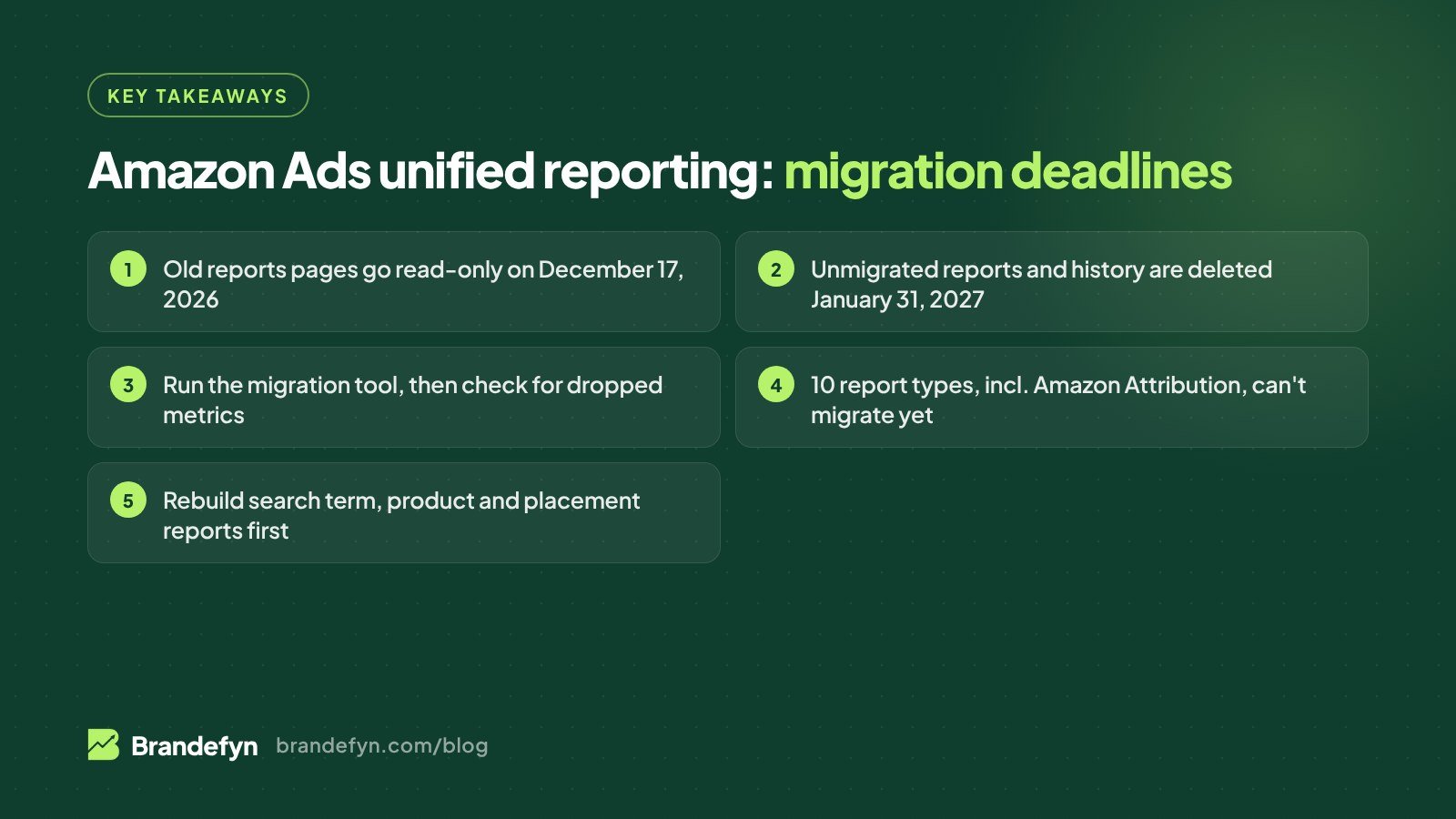
| December 17, 2026 | Old reports pages go read-only. You can't create or edit reports there |
| January 17, 2027 | 14-day warning phase starts |
| January 31, 2027 | Old pages decommissioned. Remaining saved reports, schedules and historical data are deleted |
The pages being retired are the sponsored ads reports page and the Display, Video and Audio (DVA) campaigns reports page (DVA is the new name for Amazon DSP).
Amazon's wording on January 31 is blunt: reports that aren't migrated by then "will be permanently deleted."
Our advice: treat December 17 as your real deadline. After that you can't fix or recreate anything on the old page, and late December is the worst time to discover a broken search term schedule.
What doesn't migrate (and what gets lost)
The migration is not a perfect copy. Per Amazon's support page, as summarized by PPC Land:
- Only active saved or scheduled reports from the last 24 months can be migrated.
- Fields without an equivalent are dropped. If a metric can't be supported at the same level, it is left out of the migrated report.
- Some metrics lose detail. For example, top-of-search impression share is available only at campaign level in unified reporting, not keyword level.
And ten report types are not yet supported in unified reporting, with no date given:
- Pricing transparency
- Conversion path
- Amazon Attribution
- Sponsored Products retailer dimension
- Sponsored Products or Sponsored Brands prompt reports
- Sponsored Products Video
- Industry standard
- Benchmark
- Sponsored Products budget
- Amazon Business Sponsored Products placement
If you rely on any of these, download the history you need before January 31, 2027. That's especially true for Amazon Attribution if you send TikTok, Meta or Google traffic to Amazon and judge those channels on attribution data.
How to migrate your Amazon PPC reports: a step-by-step checklist
Here's the process we're running for client accounts.
- List what you actually use. Open the old sponsored ads reports page and write down every saved and scheduled report, who receives it, and what decision it feeds (negatives, bids, budgets, inventory).
- Delete what nobody reads. There's no point migrating ten reports nobody opens.
- Run the self-service migration tool. On the old reports page, click the start button on the migration banner, confirm the pop-up, then check the migration status table for any report that failed.
- Rebuild failed or complex reports by hand. In unified reporting, start from the closest template (Search term, Advertised product, Placement, Campaign) and add the columns and filters you need.
- Compare old and new numbers. Run the same date range in both for one or two reports. Because attribution was standardized across ad products, small differences are possible. Find them now, not after the old page is gone.
- Check for missing metrics. Look for anything that was dropped, especially top-of-search impression share by keyword. Decide how you'll replace it.
- Download history. Use the History option in the Actions menu on the old page to save past reports, and export anything from the ten unsupported report types.
- Update every downstream tool. Spreadsheets, dashboards and tools that read emailed or downloaded reports may break if column names change. Test them on the new files.
- Finish before December 17. After that date the old page is read-only.
Unified reporting templates to set up first
If you only rebuild five reports, make it these. They cover most of the weekly work in a healthy Sponsored Products account.
| Report | Run it | What you use it for |
|---|---|---|
| Search term | Weekly | Find converting terms to move to exact match, and wasted terms to add as negatives |
| Advertised product | Weekly | ACoS, spend and sales by ASIN, so you can cut or push products |
| Placement | Weekly or every two weeks | Set top-of-search and product page bid adjustments |
| Campaign | Daily or weekly | Budget pacing and spotting campaigns that run out of budget |
| Converted product | Monthly | See which products shoppers actually bought after clicking your ad (halo sales) |
The search term report is the one to protect most. It drives the broad-to-exact workflow we explain in our guide to Amazon match types, and it's the fastest way to stop paying for clicks that don't sell. Note that Amazon's Sponsored Products search term report only includes terms that got at least one click.
Why this is a good moment to clean up your PPC reporting
A forced migration is annoying, but it's also a chance to fix reporting that has grown messy over the years.
Cross-account and cross-country reports. If you sell in the US and Europe, you can now build one report across countries and accounts instead of stitching CSVs together. That makes it much easier to compare ACoS by marketplace.
One view across ad types. Sponsored Products, Sponsored Brands, Sponsored Display and DVA now share standardized metrics, which makes total ad spend and return easier to see in one place.
Fewer, better reports. Old accounts often collect scheduled reports that nobody reads, while missing the one or two that would change decisions. Rebuild only what feeds a decision.
This also fits the wider shift in Amazon Ads toward AI and automation, which we covered in our AI Amazon PPC 2026 guide. The more Amazon automates bidding and targeting, the more your own reporting is how you check that the automation is spending your money well.
If you sell in the UK or EU
The change is not US only. Amazon's launch announcement lists unified reporting as available in the UK, Germany, France, Italy, Spain, the Netherlands and 11 other European countries, along with North America, Brazil, the Middle East and Asia Pacific. The same old reports pages are being retired, so the same deadlines apply to your amazon.co.uk and amazon.de campaigns.
Two things make this worth doing carefully in Europe:
- Multi-country reports. If you run ads in several EU stores, set up one report across countries with spend and sales by marketplace. Remember that each store reports in its own currency (GBP for the UK, EUR for most EU stores), so check how totals are shown before you add them up.
- Year-over-year history. If you launched in new EU countries in 2025 or 2026, download the old history now so you still have it for next year's comparisons.
The bottom line
Unified reporting is a better tool than the pages it replaces. The risk is purely in the migration: reports that are never moved get deleted on January 31, 2027, and from December 17 you can't change anything on the old page. Spend an hour this week listing your reports, running the migration tool, rebuilding the search term, advertised product and placement reports, and downloading your history.
If you'd rather have someone else handle it, our Amazon PPC management team sets up reporting as part of every account rebuild, and our weekly PPC management process runs on exactly these reports. Want a second opinion first? Get a free Amazon audit and we'll show you where your ad spend is going.
Sources
- Amazon Ads: Streamline campaign analysis with unified reporting, now generally available
- Amazon Ads UK: Unified reporting launch announcement
- PPC Land: Amazon advertisers will lose unmigrated reports on January 31, 2027
- PPC Land: Amazon Ads unified reporting exits beta, and takes two old tools with it
- SellerRoot: How to download Amazon PPC reports in unified reporting