 Brandefyn

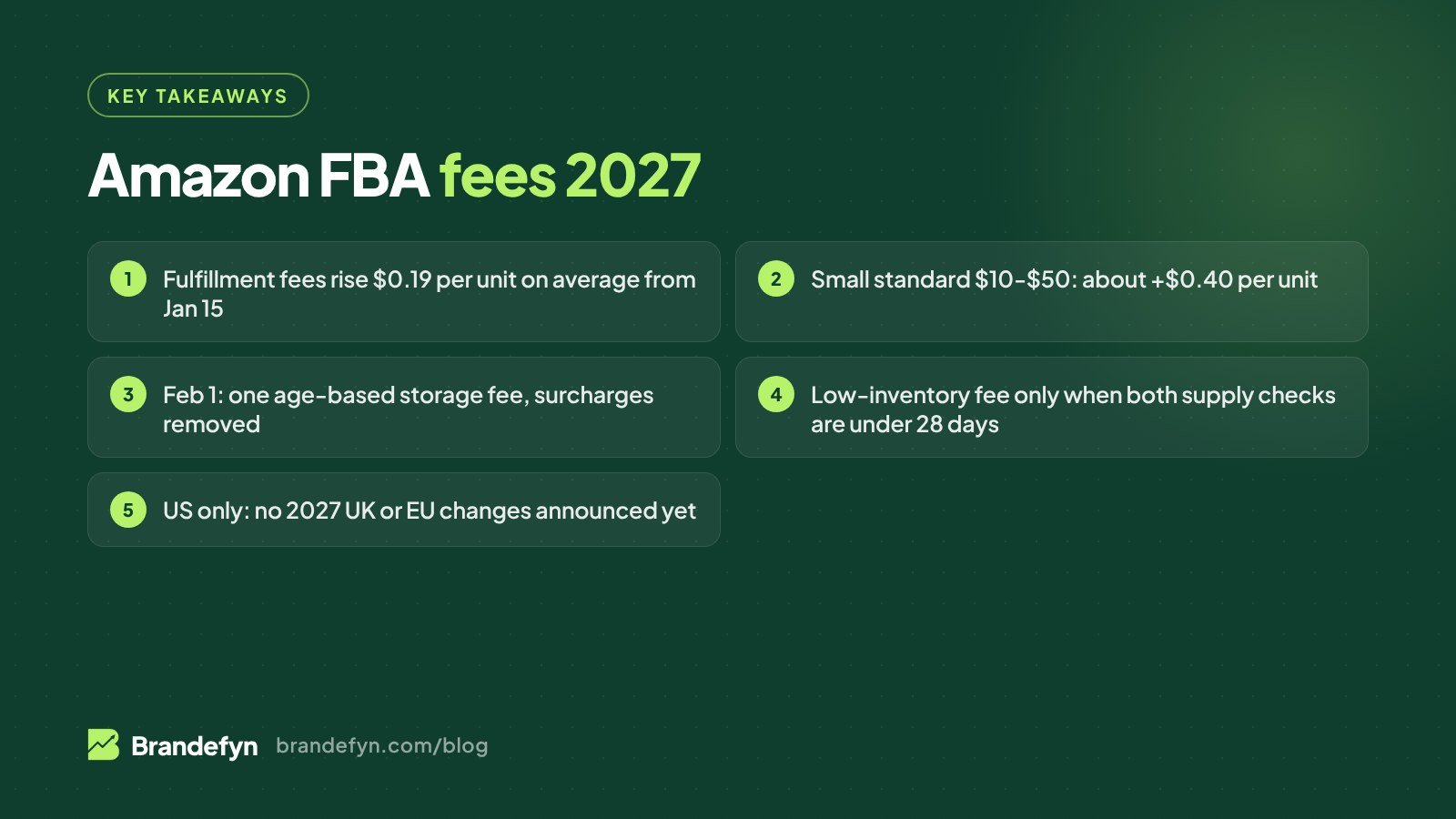
Short answer: Amazon's 2027 US fee changes raise FBA fulfillment fees by $0.19 per unit on average from January 15, 2027, about 0.8% of the average selling price. Small standard-size products priced $10 to $50 go up about $0.40 a unit, and those above $50 about $0.70. From February 1, 2027, Amazon also removes the storage utilization and aged inventory surcharges, replaces them with one age-based monthly storage fee, and changes how the low-inventory-level fee is measured. The winners will be sellers who turn inventory in under six months and keep at least four weeks of stock. Recheck your margins by SKU now, before Q1 pricing is set.
Amazon announced the changes on November 5, 2026. They apply to the US store, plus a few cross-border services that ship from the US to Canada, Mexico and Brazil. If you sell on amazon.co.uk or the EU stores, skip to the UK and EU section near the end.
Amazon FBA fee changes 2027: the key dates
| Date | What changes |
|---|---|
| Nov 5, 2026 | Changes announced. New 3D printer referral fee starts |
| Jan 14, 2027 | Holiday peak fulfillment fees end |
| Jan 15, 2027 | New fulfillment fees, new bulky and oversize tiers, new oversize handling fees, Apparel and Shoes returns changes |
| Feb 1, 2027 | Unified age-based storage fee, storage surcharges removed, new low-inventory-level fee test, other returns changes, AWD and MCD changes, monthly billing for promotions |
| Mar 1, 2027 | Age-based storage for Amazon Warehousing and Distribution (AWD) |
| Oct 18, 2027 | 10% promotional referral fee for Amazon Renewed ends |
How much are FBA fulfillment fees going up?
Amazon's headline number is $0.19 per unit on average. For comparison, the 2026 increase averaged $0.08 per unit, so this one is more than twice as large.
The average is misleading for most brands, because the increase is not spread evenly. Here are the average changes by size tier and price band for non-apparel products, as reported from Amazon's announcement:
| Size tier and price | Average change per unit |
|---|---|
| Small standard, under $10 | +$0.20 |
| Small standard, $10 to $50 | +$0.40 |
| Small standard, above $50 | +$0.70 |
| Large standard, under $10 | No change (apparel +$0.08) |
| Large standard, $10 to $50 | +$0.12 |
| Large standard, above $50 | +$0.47 |
Two things stand out. First, small, light, mid-priced products, which is where a lot of beauty, supplement and accessory brands sit, take the biggest hit in cents per unit. Second, premium products above $50 go up the most in absolute terms.
The 3.5% fuel and logistics surcharge that started on April 17, 2026 stays in place, and it is not included in the published rate cards. Build it into your own math.
To see what this means for you, do the simple math. A brand shipping 10,000 small standard units a month at $25 would pay roughly $4,000 more per month at the average rate for that band, before the surcharge. That is real money on a product with a 15% net margin.
Bulky and oversize products
Amazon is also reworking its larger size tiers. The overmax handling fee ($17, $21 and $25 in 2026) ends on January 14. From January 15, it is replaced by a flat product handling fee for each oversize tier (for example $8.40 for small oversize and $29.53 for special heavy) and an overhang handling fee for long and special oversize items. Some large items go down and others go up sharply. PPC Land's examples include a 65-inch TV box falling from $48.57 to $36.55, while a 97-inch bulletin board rises from $50.93 to $69.75.
Low-price FBA gets narrower
Products under $10 in five categories lose the low-price FBA rates and will pay the $10 to $50 rates from January 15: Automotive and Powersports, Compact Appliances, Musical Instruments and AV Production, Media, and Computers. If you sell cheap accessories in any of these, check every SKU.
Storage fees in 2027: one age-based rate
This is the biggest structural change, and for many sellers it is good news.
From February 1, 2027, Amazon removes the storage utilization surcharge and the aged inventory surcharge in the US. Both are folded into a single monthly storage fee that depends on how long each unit has been stored. Amazon says inventory that sells within about six months will see flat or lower storage fees, while aged inventory will pay more.
Goat Consulting's read of the new rate card puts standard-size storage at $0.78 per cubic foot for units stored 0 to 180 days, then $2.78 for 181 to 270 days, with steeper rates after that, plus a peak add-on from October to December. Confirm the final rates in your Seller Central fee summary, but the direction is clear: slow stock gets expensive fast.
What this means in practice:
- Fast-moving brands with good forecasting win. If you were paying the utilization surcharge because of a low sell-through ratio, that cost goes away.
- Slow movers and over-ordered seasonal stock lose. Anything you expect to sit past six months should be cleared, bundled or removed before it ages into the higher tiers.
- AWD is not a free parking lot either. From March 1, 2027, AWD inventory stored more than 12 months is charged 2.5 times the standard rate.
The new low-inventory-level fee test
The low-inventory-level fee punishes you for running too lean. From February 1, 2027, Amazon changes how it decides when to charge it:
- Amazon looks at actual shipments in the four weeks before and the four weeks after the assessment date.
- The fee applies only when both your trailing and your following days of supply are below 28 days.
- The fee now also covers all oversize tiers, not just standard and bulky.
The per-unit rates for standard and bulky sizes don't change. For a small standard-size item, it is $0.89 below 14 days of supply, $0.63 at 14 to 21 days and $0.32 at 21 to 28 days.
Exemptions include new Professional sellers for their first 365 days, new-to-FBA products in the New Selection program for their first 120 days or 200 units, SKUs mostly auto-replenished through AWD, products that shipped fewer than 20 units in the past seven days, and grocery.
Third-party analysts expect the new test to cut charges caused by sudden sales spikes and end-of-season products. The fix is the same as before: keep more than four weeks of supply at Amazon on your sellers, and don't let a deal event drain you to zero.
Other 2027 changes worth knowing
- Returns processing: rates move to the new size tiers. Apparel and Shoes change on January 15; other high-return categories on February 1. Sellers shipping fewer than 25 units a month stay exempt.
- Referral fees: a new 3D printer rate of 12% on the first $200 and 5% above that, and Amazon Renewed keeps a 10% promotional rate through October 18, 2027. No broad referral fee changes were announced.
- Buy X, Get Y promotions: a new fee of $5 upfront plus 2% of sales, capped at $2,000. All promotions move to monthly billing from February 2027.
- Inbound: no change to the inbound placement fee rate card, but central inbound regions for standard-size products shrink from three to two (East and West).
- Multi-Channel Fulfillment and Buy with Prime: standard-speed fees rise 3.5% on average; expedited fees are flat on average.
- New Selection: up to $600 in value per new product, double the previous offer, covering the first 200 units.
What US sellers should do before January 15: a 7-step checklist
- Pull your top 50 SKUs by units and re-run fees. Use Amazon's Revenue Calculator or the fee preview in Seller Central once the 2027 rates show. Don't rely on the $0.19 average. Our free Amazon profit calculator helps you see the margin impact per SKU.
- Flag SKUs in the worst bands. Small standard items priced $10 to $50 or above $50 are where the increase is largest.
- Check your packaging. A small change in dimensions can move a product into a cheaper tier. Shaving half an inch can be worth more than any price test.
- Decide on price. If a product can carry a small price increase, plan it for January, after the holiday rush. Our guide to AI pricing strategy on Amazon covers how to test it without losing the Buy Box.
- Clear aged stock before February 1. Run deals, bundle slow movers or create removal orders for anything heading past 180 days.
- Set a 4 to 8 week stock target. Enough to avoid the low-inventory-level fee, not so much that units age into higher storage tiers. This is now a margin lever, not just an ops task.
- Re-set your ad targets. Higher fees mean a lower break-even ACoS. Update your target ACoS or TACoS per SKU before Q1 campaigns go live. See how we approach this in our Amazon PPC management services guide.
Brands that already run tight inventory will feel this the least. Our $24M supplement brand case study shows what steady, mostly organic sales look like when stock and ads are managed together.
If you sell on Amazon UK or in the EU
These changes are for the US store only. As of October 30, 2026, Amazon had not announced 2027 fee changes for amazon.co.uk, according to UK fulfilment firm Angler. Here's what UK sellers know so far:
- UK standard-size storage outside clothing drops back to 76p per cubic foot per month on January 1, 2027, after the £1.51 peak rate.
- The festive peak fulfilment fee ends on January 14, 2027, and Amazon says non-peak rates from January 15 are unchanged from 2026.
- The 1.5% fuel and logistics surcharge in the UK, in place since April 17, 2026, has no end date.
Last year Amazon announced its European fee update on December 2, 2025, with changes from mid-December to February 1, 2026. Expect a similar separate notice for the UK, Germany, France, Italy, Spain and the Netherlands, and don't apply US numbers to your EU forecasts.
The bottom line
The $0.19 average sounds small, but small standard products in the $10 to $50 band and premium products above $50 will pay noticeably more from January 15. The good news is in storage: from February 1, brands that sell through stock within six months pay less, and the low-inventory fee gets fairer. The brands that lose will be the ones with slow, aged stock and ad targets set on last year's margins.
If you want a second pair of eyes on your 2027 numbers, get a free audit. Our Amazon inventory management service plans stock levels, removals and replenishment so you stay out of both the low-inventory fee and the aged storage tiers. For more ways to protect margin, read how to increase Amazon CPG sales.
Sources
- PPC Land: Amazon sellers face average $0.19 FBA fee rise from January 15, 2027
- Goat Consulting: 2027 Amazon FBA fee changes and full FBA rate card
- Nova Data: Amazon 2027 FBA fee changes, $0.19 more per unit from January 15
- beBOLD Digital: Amazon 2027 US referral and FBA fee updates
- AMZ Prep: Amazon FBA fees 2027
- Angler Fulfilment: Amazon FBA fees 2027 UK, what is confirmed so far