 Brandefyn

Short answer: Since November 1, 2026, every B2C parcel shipped into the EU from outside the EU pays a new €2 EU customs handling fee per customs item, at any order value, with no refund on returns. It sits on top of the €3 flat customs duty per item that has applied to consignments of €150 or less since July 1, 2026. That means UK and US sellers shipping single orders to amazon.de, amazon.fr, amazon.it, amazon.es or amazon.nl customers now pay at least €5 per product line before VAT. Orders shipped from stock already inside the EU do not pay either charge.
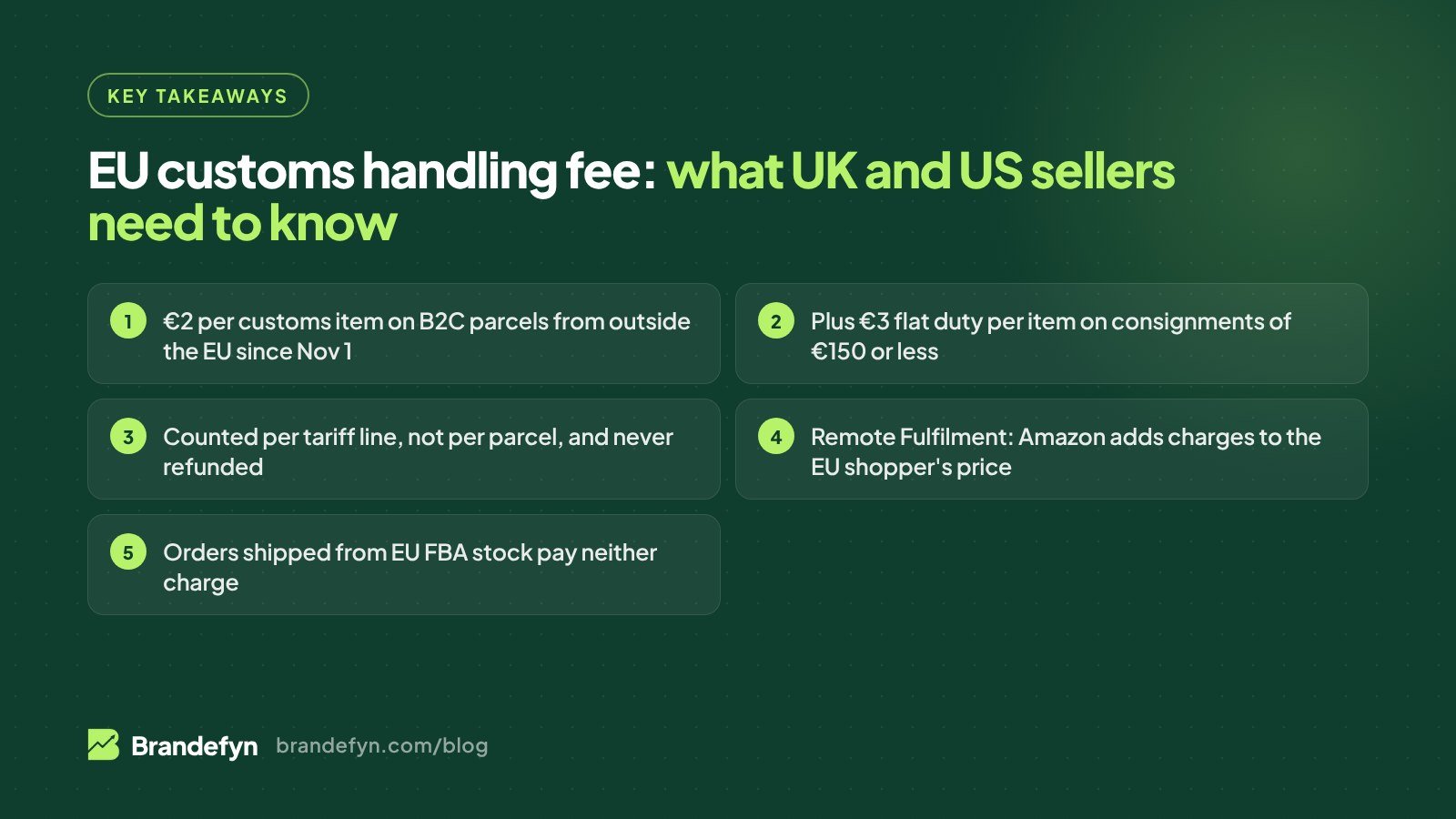
This is a UK and EU post. If you only sell on amazon.com and ship to US customers, nothing here changes for you. If you sell into Europe from the UK or the US, through Amazon or your own Shopify store, read on before Christmas pricing is locked in.
What changed on November 1, 2026
The EU spent 2026 closing the gap that let low-value parcels in without customs duty. It happened in three steps:
| Date | What changed | Who it hits |
|---|---|---|
| July 1, 2026 | €150 duty exemption ends. A flat €3 customs duty per item applies to B2C consignments of €150 or less | Non-EU sellers shipping direct to EU consumers |
| November 1, 2026 | New €2 Union handling fee per item, at any value. Product identifiers become mandatory on low-value import declarations | Same sellers, now including orders above €150 |
| July 1, 2028 | €3 flat duty is scheduled to end and normal tariff rates take over, tied to the EU Customs Data Hub | All B2C imports |
The €2 fee comes from Commission Delegated Regulation (EU) 2026/2152, published in the EU's Official Journal on October 22, 2026. The €3 duty comes from Council Regulation (EU) 2026/382. They are two separate charges, and a parcel can pay both.
How much does the EU handling fee cost per order?
Both charges are counted per customs item, not per parcel and not per unit. An item is a group of goods with the same tariff classification, description and origin. In practice, that is one line on the customs declaration.
| Example order (under €150) | Customs items | €3 duty | €2 fee | Total before VAT |
|---|---|---|---|---|
| 5 identical T-shirts | 1 | €3 | €2 | €5 |
| 1 T-shirt + 1 watch | 2 | €6 | €4 | €10 |
| 3 different product types | 3 | €9 | €6 | €15 |
| 1 item, order worth €200 | 1 | Normal duty rate | €2 | €2 + normal duty |
A few details matter for your margin math:
- The fee applies at any value. Above €150 the €3 flat duty no longer applies, normal duty rates do, and the €2 fee still applies per line.
- It is not refundable. The fee pays for customs processing, so it is not returned for refused, failed or returned parcels.
- It goes into the VAT base. Under the European Commission's revised VAT guidance from October 6, 2026, both the duty and the fee form part of the taxable amount. At 21% VAT, €10 of charges becomes €12.10.
- Declaration type changes the count. The EU's own guidance says three goods with the same 6-digit code but different 10-digit codes cost €3 on a simplified H6 or H7 declaration, but €9 on a full H1 declaration. Ask your carrier which one they file.
Who pays: you, the carrier or the customer?
Legally, the charges are owed by the customs declarant. Depending on your setup, that is the IOSS-registered seller or its representative, the postal or courier company, or an indirect representative. In practice the buyer bears the cost, either in the price at checkout or as a charge the carrier collects at the door.
How it works on Amazon depends on how you fulfil the order:
Remote Fulfilment with FBA (UK to EU)
Remote Fulfilment lets you keep stock in UK fulfilment centres and sell to customers in Germany, France, Italy and Spain. Amazon collects and remits import charges on these orders. According to Amazon's notice, it adds the EU charges to the price shown on the detail page, in the basket and at checkout. So EU shoppers may see a higher price than the one you set, while Seller Central still shows your price without them. That makes a UK-shipped offer less competitive against sellers holding stock in the EU.
Merchant-fulfilled orders shipped from the UK or US
For FBM orders, the carrier invoices you for the charges and pays them to EU customs. Amazon's guidance for the €3 duty asks FBM sellers to use Amazon-approved carriers, give the carrier ASIN details and Amazon's IOSS number, and keep shipping delivered duty paid (DDP) so customers aren't hit with a charge at the door. You pay the carrier, so the €2 and €3 come straight out of your margin unless your price covers them.
Pan-European FBA and EU stock
Inventory already in an EU fulfilment centre was imported as a business shipment, paying normal duty and import VAT once on the whole pallet. Orders shipped from that stock to EU customers are not imports, so no €2 fee and no €3 duty per order. Amazon's own supply chain team points to the same route for off-Amazon orders: send stock to Amazon's EU network and fulfil Shopify or TikTok Shop orders through Multi-Channel Fulfillment from inside the EU.
The catch: holding stock in an EU country means a VAT registration in each country where goods are stored, and stock moved between EU countries must be declared in both.
What UK and US sellers should do now: a 7-step checklist
- List your cross-border SKUs. Pull every product you ship to EU customers from outside the EU: Remote Fulfilment ASINs, FBM offers on EU stores and Shopify orders to EU addresses.
- Check the tariff codes. Wrong or split codes create extra customs lines. One correct code per product keeps the fee at €2, not €4 or €6.
- Ask your carrier three questions. Which declaration type do they file (H1, H6 or H7)? How do they pass the €2 fee and €3 duty back to you? Is the fee added to your shipping rate or your invoice?
- Re-price EU offers by line, not by parcel. A single-product order now carries at least €5 in charges below €150. For a €15 accessory, that is a third of the price before VAT.
- Review repricer rules. If Amazon adds charges to your customer-facing price, a repricer that only sees your set price can push you out of the Buy Box without you noticing.
- Add product identifiers. From November 1, product identifiers are mandatory on low-value import declarations. Carriers ask for your own SKU, a supplier or factory reference, and a GTIN, EAN or UPC where you have one. Missing data can mean held or refused parcels.
- Run the EU stock math. If a SKU sells steadily in Germany or France, compare per-order charges with the cost of a bulk import, EU VAT registration and storage. For best-sellers, EU stock often wins. For long-tail SKUs, cross-border may still be cheaper.
Stock planning is where this decision lives. Our guide to Amazon FBA fees in 2027 covers the storage side, and AI pricing strategies for Amazon explains how to set repricer floors that account for extra costs.
Watch for national fees too
Some EU countries have tried their own parcel fees on top of the EU charges, and they change often. As of mid-November 2026:
- Italy: a national €2 fee per consignment up to €150, postponed to December 1, 2026. Italy's draft 2027 budget would abolish it.
- France: a €2 fee ran from March to June 2026 and has been suspended since July 1, 2026.
- Romania: a national fee applied from January 1, 2026 and was repealed on October 30, 2026.
Check the rules for each country before you set prices for Q1.
What this means for US sellers
US brands are affected in exactly the same way as UK brands when they ship from the US to EU consumers. That includes FBM orders on amazon.de or amazon.fr and DTC orders from a Shopify store to EU addresses. If Europe is a meaningful slice of your sales, the per-order charges are now a real argument for holding stock in the EU, either through Amazon's EU network or a third-party warehouse. If Europe is a test market, price the €5 per line into your offers and keep it cross-border until volume justifies the setup.
If you run ads in several EU stores, our guide to Amazon Ads unified reporting shows how to see all your European countries in one report, so you can tell which markets still make money after these charges.
The bottom line
The €2 EU customs handling fee is small per parcel but permanent, charged at any value and never refunded. Together with the €3 duty, it adds at least €5 per product line to every low-value order you ship into the EU from the UK or the US. Sellers who check tariff codes, re-price by line and move best-sellers into EU stock will keep their margins. Sellers who leave Remote Fulfilment and FBM prices untouched will quietly lose the Buy Box or their margin.
Want a second opinion on where your EU stock should sit? Get a free audit. Our Amazon inventory management service plans stock placement, replenishment and cross-border fulfilment so every European order still makes money.
Sources
- EU Access2Markets: EU applies €3 customs duty per item on low-value e-commerce consignments
- ChannelMAX: Amazon UK outlines €2 EU customs handling fee from November 1
- ChannelX: How Amazon will handle B2C low-value imports into the EU
- hellotax: EU €3 customs duty and €2 handling fee explained
- Taxually: EU €2 handling fee and €3 customs duty
- Avalara: EU inbound customs handling fee, guide for UK sellers
- Landmark Global: EU customs reform, new B2C import rules for November 2026
- Amazon Supply Chain UK: EU customs de minimis changes
- Amazon UK: Remote Fulfilment between the UK and EU