 Brandefyn

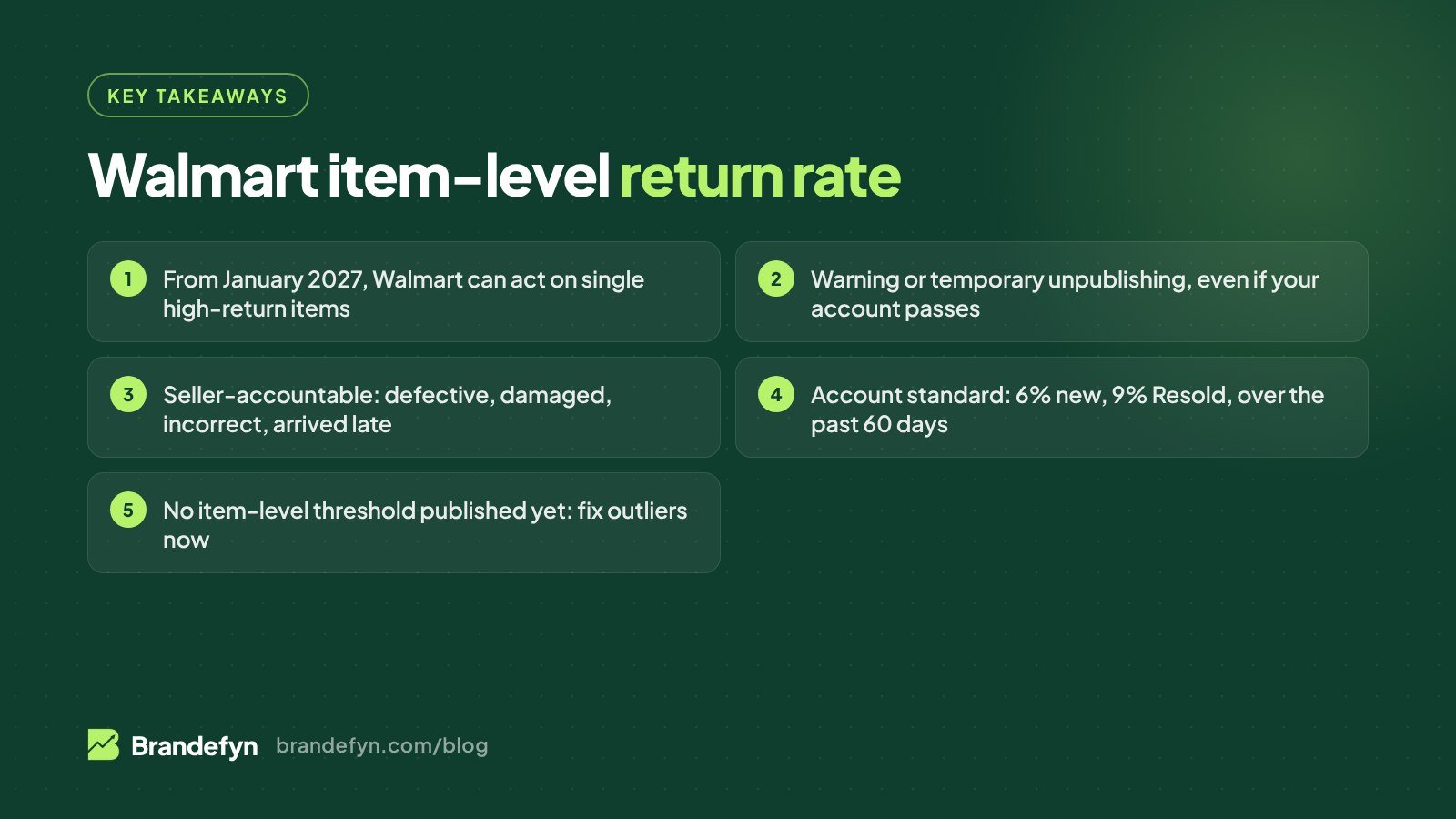
Short answer: Starting in January 2027, Walmart will judge return rates item by item, not just across your whole account. Items with high rates of seller-accountable returns (defective, damaged, incorrect or late) may get a warning or be temporarily unpublished, even if your overall Return Rate meets Walmart's 6% standard. Walmart hasn't published an item-level threshold. Check your worst items now in Seller Center under Returns, then View returns insight, and fix the cause before January.
This is a US story. The rules below come from Walmart Marketplace's Seller Center guides for Walmart.com sellers. Walmart doesn't run a marketplace in the UK or EU.
What Walmart announced
On November 6, 2026, Walmart posted a release note titled "Prepare for item-level Return Rate enforcement." The key line:
"Beginning in January 2027, items with high rates of seller-accountable returns may receive a warning or be temporarily unpublished, even if your overall Return Rate meets the Seller Performance Standard."
Walmart says it will provide Return Rate metrics at the item level in addition to your overall Return Rate, so it can "take targeted action rather than automatically affecting your entire catalog."
That cuts both ways. A good account can no longer hide one bad product behind thousands of clean orders. But a single problem SKU also shouldn't drag down the rest of your store, as long as you fix it.
Walmart updated its Return Rate guide the same day. It now says Walmart "also monitors Return Rate for individual items," and that broader or repeated problems may lead to more action under the Seller Performance Standards.
How Walmart's return rate works today
Here's what Walmart's own guides say, as of November 2026:
| Rule | What Walmart says |
|---|---|
| What it measures | Delivered items returned for seller-accountable reasons |
| Lookback window | Past 60 days |
| Account standard, new inventory | 6% or below |
| Account standard, Resold inventory | 9% or below |
| Item-level threshold | Not published |
| Seller-accountable reasons | Defective, damaged, incorrect item, arrived late |
| WFS items | Most performance metrics, including Return Rate, are met for you |
| Item-level action (from January 2027) | Warning or temporary unpublishing |
| Account-level action if standards are missed | Possible suppression, suspension or termination |
Return Rate is one of eight Seller Performance Standards. The others include Cancellation Rate (2% or below), On-Time Delivery Rate (90% or above), Valid Tracking Rate (99% or above) and Item Not Received Rate (2% or below). Walmart notifies sellers by email and in Seller Center when an account misses a standard.
Why an account-level pass is no longer enough
Say your account returns 4% of delivered items. You pass. But one item inside that number could be returning far more, because high-volume clean items pull the average down. Until now that item was safe. From January, Walmart can act on it directly.
Walmart hasn't said what counts as "high" for a single item. Treat any item well above your account average as at risk, and any item above 6% as a priority.
Why January is the risky month
Two things line up in January:
- The 60-day lookback covers the holidays. In January, your Return Rate window includes items delivered in November and December, your highest-volume weeks.
- Holiday returns arrive late. Walmart told sellers that most items bought from October 1 through December 31, 2026 can be returned through January 31, 2027, instead of the standard 30 days. Wireless phones, protection plans, major appliances, Dyson products, food and beverages, and select seasonal and luxury goods are excluded.
So a product with a packaging or listing problem in December may show its full return rate right when item-level enforcement begins. Fixing it in February is too late. Black Friday and Cyber Monday are when to find these items, not after.
How to find your high-return items in Seller Center
Walmart points sellers to one place: the Returns page in Seller Center, then View returns insight. There you can see each item's return rate, units returned and top return reasons.
Per Walmart's Returns insights guide, the dashboard shows:
- Total returns and units returned for the date range you pick
- Return rate, the share of delivered items returned (seller-fulfilled orders)
- Item not received %, which must be 2% or less
- Refund rate and refund GMV
- Returns processing fee
- A Returns reasons column; click the number to see why customers sent the item back
You can filter by item name, SKU or item ID. Walmart notes the dashboard's refund rate may differ from the one used for Seller Performance Standards, so use it to find problems, not as your official score.
A 7-step checklist to fix high-return items before January
Work through your top 20 items by return volume first.
- Pull a 60-day item list. In Returns insights, set the last 60 days and sort by return rate. Flag anything above 6% or well above your account average.
- Read the top return reason for each flagged item. The reason tells you where the fix is. Don't treat all returns the same.
- "Damaged": fix packaging and handling. Look at how the item is packed, the box strength, void fill and whether fragile items are marked. Check whether damage clusters with one carrier or warehouse.
- "Incorrect item": fix variants and picking. Wrong color, size or count usually means a variant mapping error, a wrong UPC or GTIN, or a picking mistake. Compare what's in the listing, the system and the bin.
- "Defective": go back to the supplier. Ask for a quality check on the current lot. If the defect rate is high, pause the item rather than let it build a bad record.
- "Arrived late": fix the promise, not just the shipping. Lengthen your shipping template where you can't deliver on time, or move the item to WFS. Late delivery also hurts your On-Time Delivery Rate.
- Rewrite the listing to set honest expectations. Many returns start with a listing that over-promises. Make dimensions, materials, compatibility, count and images exact. Walmart's Listing Quality score already rewards complete content; see our guide on making Walmart listings readable for Sparky and AI shopping agents.
Keep a dated log of every change you make to a flagged item. If Walmart warns or unpublishes it, that record is what shows you found and fixed the cause.
Use return rules where they make sense
Returns insights also offers category rule recommendations. They can add Replacement, Keep it or Partial keep it return rules, with an estimated yearly savings forecast. A "Keep it" rule on a low-priced item can be cheaper than paying for return shipping. Review these per category, because they change your costs, not the root cause of the return.
Should you move high-return items to WFS?
Walmart says that with Walmart Fulfillment Services (WFS), most performance metrics are met for you, including Return Rate. For seller-fulfilled items with "damaged" or "arrived late" problems, WFS can be a real fix, since Walmart handles storage, packing and delivery.
But WFS is not a hiding place. A defective or wrongly described product still gets returned, still costs you the sale and fees, and still earns bad reviews. Fix the product or the listing first, then decide whether WFS makes sense on cost. Our Walmart WFS setup service covers that decision.
If you also sell on Amazon
Amazon is changing returns costs at the same time. Its 2027 fee update moves returns processing fees to the new size tiers, with Apparel and Shoes changing on January 15 and other high-return categories on February 1. Details are in our Amazon FBA fees 2027 guide.
The same products tend to have high returns on both marketplaces. One root-cause review, done once, protects you on Walmart's new rule and cuts your Amazon returns bill too.
What we don't know yet
Walmart's notice leaves a few gaps. We'll update this post when Walmart publishes more:
- The numeric item-level threshold that triggers a warning
- The exact start date in January 2027
- How long a temporary unpublish lasts and how reinstatement works
- How Walmart treats items with very few delivered units
Until then, plan around what Walmart has said: item-level metrics, a 60-day window, four seller-accountable reasons, and warnings or unpublishing from January.
The bottom line
From January 2027, every Walmart item has to pass on its own. Your account average no longer protects a product that returns too often. Open Returns insights this week, list the items above 6%, find the top return reason for each, and fix packaging, variants, quality, delivery promises or listing content before holiday returns land in your 60-day window.
Want a second pair of eyes? Get a free audit of your Walmart store, or see our Walmart account management service, where we monitor performance standards, return rates and listings every month.
Related: TikTok Shop sales dropped? How to diagnose the cause before Black Friday.
Sources
- Walmart Marketplace Learn: Prepare for item-level Return Rate enforcement (Nov 6, 2026)
- Walmart Marketplace Learn: Return Rate guide
- Walmart Marketplace Learn: Seller Performance Standards
- Walmart Marketplace Learn: Returns insights overview
- Walmart Marketplace Learn: Holiday return window extension (Aug 31, 2026)
- EcomCrew: Walmart will pull high-return products even if your account passes